Python initial release, February 20, 1991
2024-02-27
Python, a high-level programming language, was initially released February 20, 1991, by Guido van Rossum, Netherlands, It emphasizes code readability with its notable use of significant whitespace. Its standard library supports various programming paradigms, including procedural, object-oriented, and functional programming. Python 1.0 in 1994 introduced many core features. Python 2.0 in 2000 added list comprehensions and garbage collection. Ended with 2.7. Python 3.0 in 2008 was a major rewrite, not backward compatible, with changes like print function, Unicode support, and syntax alterations. Python was named after the British comedy group Monty Python. Philosophy of the Python language: By typing "import this" into a Python interpreter, you'll be presented with the "Zen of Python" by Tim Peters, which includes aphorisms such as "Beautiful is better than ugly" and "Simple is better than complex". It is widely used for a variety of applications, from web development to data analysis and artificial intelligence. Python is one of the most popular programming languages. Its popularity is due to the rise of data science, machine learning, and its role in academic and educational settings. Python's simplicity and versatility, combined with a strong community and extensive libraries, contribute to its widespread use and ongoing popularity across diverse fields. More: https://en.wikipedia.org/wiki/Python_(programming_language) Art&Text supported by ChatGPT.

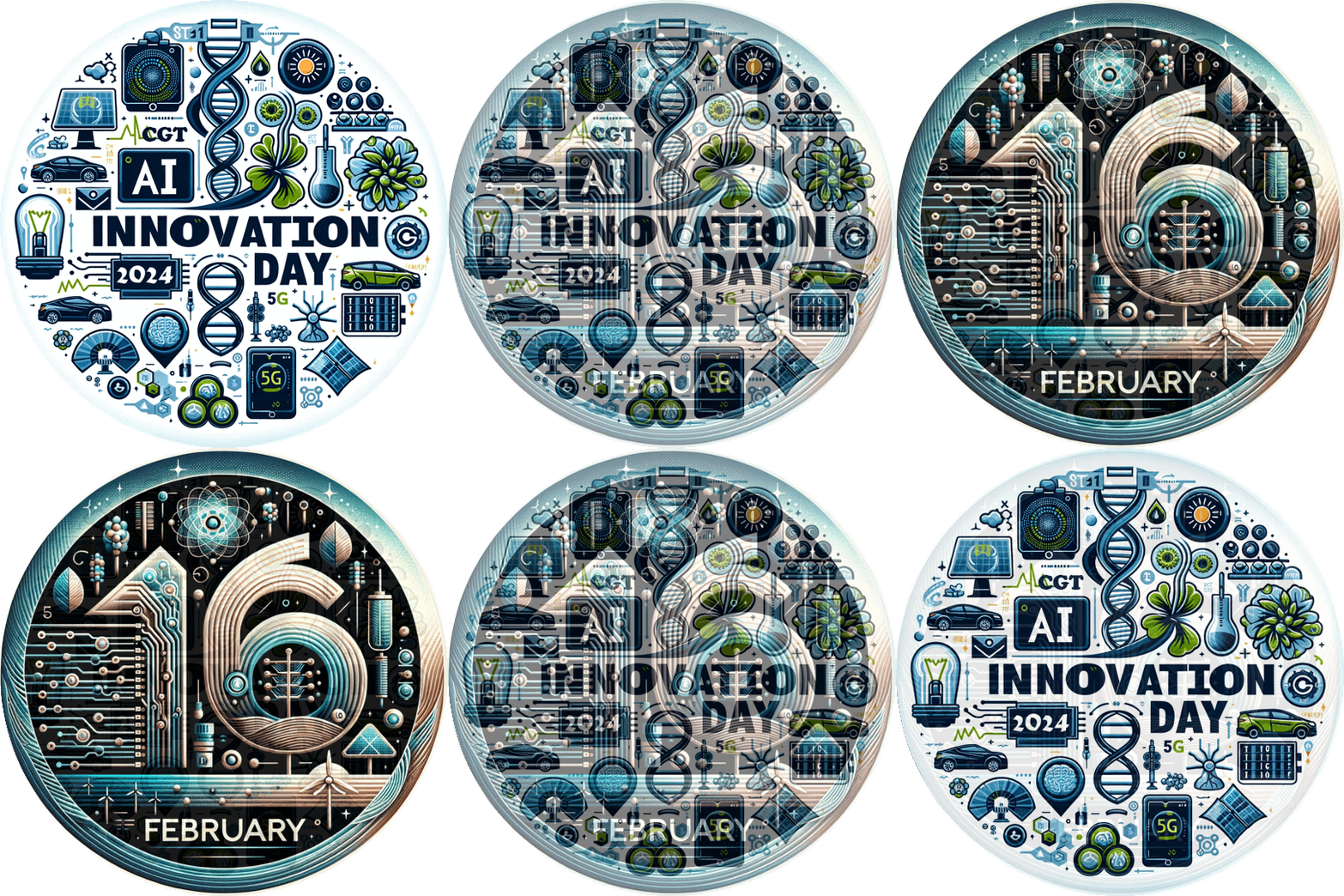
Innovation Day 2024
2024-02-27
Today we celebrate the power of human creativity and ingenuity. At its core, innovation involves implementing something new or improving an existing product or method in a way that adds value or solves problems. It's a driving force behind societal, economic, and technological progress. Examples of the last decade: Artificial Intelligence & Machine Learning: Lately with generative AI, these technologies have revolutionized industries by enabling smart automation, predictive analytics, and personalized user experiences. AI's applications range from healthcare diagnostics to autonomous vehicles, significantly enhancing efficiency and capabilities. Blockchain: Beyond its initial application in cryptocurrencies like Bitcoin, blockchain has introduced a new paradigm for secure, decentralized transactions and data management, impacting sectors such as finance, supply chain logistics, and secure voting systems. CRISPR-Cas9 Gene Editing: It allows for precise editing of DNA, offering potential cures for genetic disorders, advancements in agricultural bioengineering, and treating infectious diseases. Renewable Energy: Innovations in solar and wind energy and improved battery storage have accelerated the transition towards cleaner, sustainable energy sources, mitigating climate change impacts. 5G: Its rollout has marked a significant leap in wireless communication, offering vastly increased speed and connectivity. https://en.wikipedia.org/wiki/Innovation Art&Text 🫶 by ChatGPT.
Byron appreciation token 2023: A show of gratitude for your usage of the Bayer platform in 2023.
2023-12-23
Cheers to our global gang! 🌍🌟 As the year draws to a close, we're giving a shoutout to the 13,000 amazing contributors on our platform. By leveraging Byron, the exchange within our company becomes more seamless, paving the way for new projects and strengthening our unity within Bayer. 🚀 Presenting this exclusive POAP as a massive thank you, because without you, this platform wouldn't be what it is. 🙌 Byron, an acronym for Bayer Open Network, is our Skills database for Bayer employees, including speed networking. We kicked off in 2018 as a True North grassroots side initiative, going live in 2020. Created by over 40 students and programming enthusiasts with the help of EY Croatia. Today, we have 13,000 registered users from 89 countries, in 293 cities. People have searched for something in Byron at least 25,000 times and engaged in 31,000 1:1 Speed network meetings. http://go/byron Looking ahead, we're thrilled about the future and the prospect of our community growing even larger. Can't wait for more collaborations and successes together in the coming year! 🎉✨ Art created by Lena Schermer

I met Jan-Moritz at the Bayer POAP Open House December 2023
2023-12-05
Thanks for participating at our Bayer POAP Open House December 2023 townhall meeting!

En este evento académico, los médicos especialistas tendrán la oportunidad de conocer todo lo relacionado a esta innovación terapéutica con beneficio cardiorenal para el paciente diabético tipo 2. Con foco en la innovación y en mejorar la calidad de vida de los pacientes, Bayer también se enorgullece de promover prácticas y tecnologías Web3 innovadoras como NFT POAPs. Este es el segundo POAP NFT en Uruguay relacionado con un producto farmacéutico. Si recibió este POAP, usted es un verdadero pionero en el espacio Web 3.0. Por favor lea los términos y condiciones de Bayer POAPs en el siguiente enlace: https://bayer.com/poap Por más información sobre Bayer Web3, contacte a: jesusdelvalle@bayer.com o marianoel.sosa@bayer.com
