Chinese New Year 2024
2024-02-14
The Chinese New Year, aka Spring Festival, marks the beginning of the lunar new year and is the most significant Chinese holiday. Rooted in mythology, it's said to have originated from the ancient fight against the mythical beast Nian, with the use of firecrackers and red decorations symbolizing luck and prosperity to ward off evil spirits. It has been celebrated for over 3,500 years, evolving from sacrificial ceremonies to the gods at the year's end for good harvests. Today, it initiates with the new moon that appears between 21 January and 20 February and lasts until the full moon, encompassing generally a 15-day period filled with various rituals and festivities, culminating in the Lantern Festival. Around 1/4 of the world’s population participates. Family reunions are central to the celebrations, with millions traveling home in one of the world's largest annual human migrations, known as Chunyun. Practices include thorough house cleaning to sweep away bad fortune, decorating homes with red lanterns and couplets, exchanging red envelopes (hongbao) containing money for luck, and enjoying lavish feasts with symbolic dishes, such as fish served whole (including head and tail) symbolizing a prosperous start and finish to the year. Each year is named after an animal, believed to influence personality traits and fortune, and associated with an element. 2024 is the Year of the Wood Dragon. More: https://en.wikipedia.org/wiki/Chinese_New_Year Art&Text supported by ChatGPT.

Together Women Can is extremely happy to share its first "sisterhood story from Kenya" during the Bayer Bayron Bar Valentine's party (Berlin Germany). There will be Love&Science prompt battle pitches generated by AI. TWC presents a wonderful poem about women´s talks and knowledge sharing, all in the frame of health prevention & above all self-love. Come and collect your POAP! Remember that you value, and every one does! #empoweringwomen #ruralkenya #selflove #healthforall #cervicalcancerawereness Web: https://togetherwomencan.co/ LinkedIn: https://www.linkedin.com/company/togetherwomencan/ Email: togetherwomencan.20@gmail.com
National Periodic Table Day, celebrated on February 7th, marks the unveiling of Dmitri Mendeleev's periodic table in 1869. Mendeleev's design, arranging elements by atomic mass and properties, was revolutionary, predicting undiscovered elements and their behaviors. Today, the table lists 118 elements, a testament to scientific progress, blending nature's creations with human-made innovations. Facts: The initial 94 elements are found naturally on Earth, while the subsequent 24 have been synthetically created. Hydrogen, the simplest and most abundant element, constitutes about 75% of the universe's elemental mass. Helium, second on the table, makes up most of the remaining 25%. Astatine, the rarest natural element, is so scarce that less than 30 g (an ounce) exists in Earth's crust at any time. Argentina is named after Argentum, the Latin name for the element Silver. "The country of Silver". The periodic table's future promises expansion, with scientists seeking to synthesize new elements, pushing beyond the current limits. This day celebrates not just a scientific tool, but a symbol of human curiosity and our quest to understand the universe's building blocks. It underscores the periodic table's ongoing evolution, highlighting the endless possibilities that await in the realms of chemistry and physics. Thanks to SG for sharing with me his wonderful ideas about the Periodic Table. More: https://en.wikipedia.org/wiki/Periodic_table Art&Text supported by ChatGPT.

Bianca & Self-Love Shine at Valentine's Day! Meet Bianca at our #Valentines party, celebrating women & Kenyan culture! Her message: self-love empowers all.✨Bianca is a scientist with the passion of women´s health and enpowerment. She works as a preclinical pharmacologist in Bayer (Germany) and a women´s & reproductive health consultant at Together Women Can (Kenya). #POAP #EmpoweredWomen #selflove #womenshealth #cervicalcancerprevention

Valentine's Day, celebrated on February 14th, is a day dedicated to love and affection. Its origins can be traced to both Christian and Roman traditions. The name "Valentine" likely comes from two Christian martyrs named Valentine who lived in the Roman Empire during the 3rd century. One of the legends surrounding Valentine suggests that he defied Emperor Claudius II's ban on marriages for young men, as Claudius believed that single men made better soldiers. Valentine continued to perform marriages in secret and was eventually arrested and executed on a February 14th. Legend says, he sent a love letter to his jailer's daughter, signing it "From your Valentine," which is a phrase still used today. Valentine's Day gained popularity over the centuries. In the Middle Ages, it became associated with romantic love. In the 19th century, the exchange of love notes and cards became a common practice. Today, Valentine's Day is a global occasion. 200+ million roses are grown, 20+ Billion USD are spent, 190+ million Valentine's Day cards are exchanged in the US alone. Piquant: Among people surveyed, 20% of men purchase gifts for multiple partners, while only 6% of women do the same. Today is perfect for quality time with your partner, or, maybe, embracing the opportunity to finally express affection to your secret love. Be Decent, Virtuous and Brave and —ask them to be your Valentine! More: https://en.wikipedia.org/wiki/Valentine%27s_Day Art by Dall-E, text supported by ChatGPT.

Carnaval de Argentina 2024
2024-02-14
The Carnaval de Argentina is a vibrant and diverse celebration that varies significantly across the country, reflecting the rich tapestry of Argentine culture. Its origins can be traced back to the colonial period, with significant influences from European and Indigenous traditions. The most famous celebrations occur in the provinces of Corrientes and Entre Ríos, particularly in the cities of Gualeguaychú, Corrientes, and Concordia, each offering its unique flavor of carnival festivities. One of the hallmark features of the Argentine carnival is the "comparsa," a musical group that performs in elaborate costumes, accompanied by dancers who parade through the streets. The Gualeguaychú Carnival, often referred to as the "Carnival of the Country," is especially renowned for its spectacular floats and costumes, drawing comparisons to the Rio Carnival in Brazil. Gualeguaychú alone hosts tens of thousands of spectators each weekend of the celebration; thousands participate in over 100 murgas in Buenos Aires, "Carnaval Porteño", alone. In 2024 the Buenos Aires Carnaval ends February 13th. The Carnaval was revived in the 2000s after a decades-long ban by the military dictatorship, highlighting its importance as a cultural expression and social protest. The event is not only a display of creativity and joy but also an economic booster, attracting tourists from across the globe. More: https://en.wikipedia.org/wiki/Buenos_Aires_Carnival Art&Text supported by ChatGPT.

Carnaval do Brasil 2024
2024-02-14
The Carnival of Brazil, February 10-14 in 2024, has its origins in European colonial traditions, particularly Portuguese entrudo festivals, enriched by African and indigenous influences. It's a festivity that epitomizes Brazil's cultural diversity, with its peak expressions in cities like Rio de Janeiro, Salvador, Recife, and Olinda. It has existed since 1723. Its signature samba music and dance reflect African heritage, while the masquerade balls and street parties have European roots. At the "blocos", street parties, locals and tourists celebrate with music, dance, and costumes. There is immense preparation and community involvement. Samba schools work year-round to prepare their performances, involving communities in the creation of costumes and floats, and rehearsal of dances and songs. This communal effort underscores the festival's significance as a cultural expression and a generator of social cohesion. Rio's Carnaval, the largest of the world, has 2 million participants daily. It is famous for its Sambadrome parades, showcases samba schools competing with elaborate floats and costumes. Despite its festive nature, it also offers a stage for social commentary, with themes addressing political and social issues through samba lyrics and parade themes. This multifaceted celebration combines joy, resistance, and cultural expression, making it a profound reflection of Brazilian society. https://en.wikipedia.org/wiki/Brazilian_Carnival Art&Text supported by ChatGPT.

I met Jesus in February 2024
2024-02-14
Head of Business Disruption, Bayer Pharmaceuticals. I love Stranger Things, MoreScience4Berlin, STEM4Health, Hackathons, Biotech, Digital Health, Startups, Web3, Networking For Health, Science, Technology, Pharma, Medicine, 23andMe, Exobiology, Space, Science Fiction, Germany, Cuba. #OhrSum #Byron #ByronBar #POAP #HackAProcess #ItIsNeverTooLate https://www.linkedin.com/in/yeysus/ https://twitter.com/yeysus yeysus.eth/.tez/.near POAP collections: https://collections.poap.xyz/en-US?creator=0x74839F2fF3bb6F98E5f120329A76A89f52b95DCC Bayer Berlin: https://collections.poap.xyz/bayer-berlin/173 Commemorations: https://collections.poap.xyz/commemorations/1073 The future doesn’t belong to the fainthearted. It belongs to the Brave. - Ronald Reagan's Address to the Nation about the Explosion of the Space Shuttle Challenger, January 28th, 1986. Art Photoshop, PowerPoint, ezgif.com.

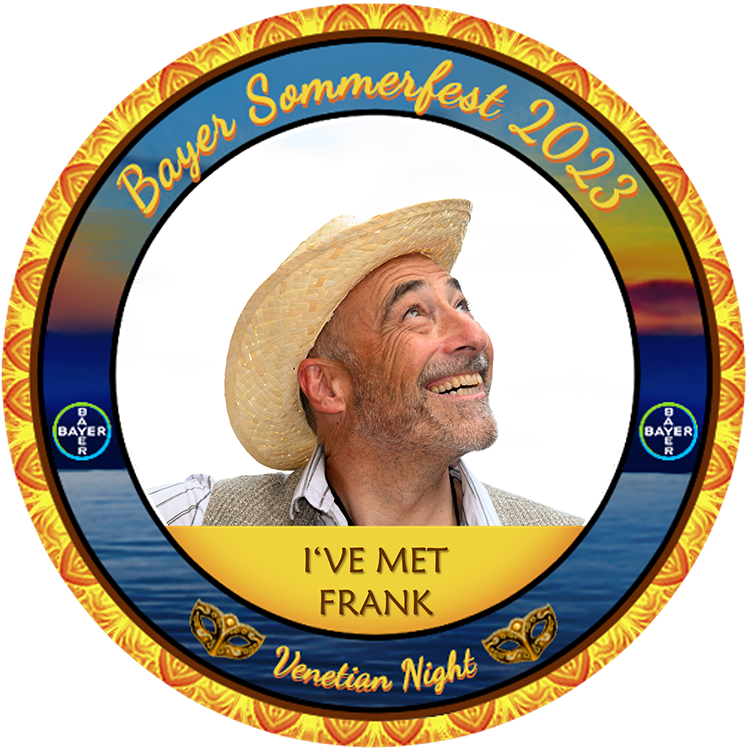
I’ve met Frank Dräger at the Bayer Berlin Sommerfest 2023. Frank is a visionary thinker - driven by passion and enthusiasm. His call: “I owe life the glow and tingle in my eyes.” Trust, empathy, loving people and the strong believe in the power of a meaningful purpose are the main principles of his life. LinkedIn: https://www.linkedin.com/in/frankdraeger/. Art by Lena Schermer. Bayer POAPs terms and conditions: https://bayer.com/poap