ERP Projects Team Workshop | Bayer
2024-03-13
Thank you for partaking in today’s introductory session! I hope that everyone could learn something along the way, improving their understanding of POAP NFTs and their use-cases within Bayer and beyond. Bayer terms & conditions apply: https://www.bayer.com/en/poap-tc

The International Organization for Standardization (ISO) starts operations, February 23, 1947
2024-02-29
The International Organization for Standardization (ISO) is an institute responsible for crafting and promulgating international standards that ensure quality, safety, and efficiency across products, services, and systems. It began operations February 23, 1947. Headquartered in Geneva, Switzerland, ISO has members from 170 nations, it has published 25,000+ international standards and it has over 800 technical committees (TCs). The organization's portfolio is extensive, covering almost every industry, from technology and manufacturing to food safety, agriculture, and healthcare. One notable standard is ISO 9001, which focuses on quality management systems. TC 307 focuses on standardization of blockchain and distributed ledger technologies. ISO 11615, "Health informatics, Identification of medicinal products, Data elements and structures for the unique identification and exchange of regulated medicinal product information", is part of a suite known as the Identification of Medicinal Products (IDMP) standards, which also includes ISO 11238, ISO 11239, ISO 11240, and ISO 16791. Collectively, they aim to improve safety, quality, and efficacy of medications worldwide. The name "ISO" is not an acronym. It is derived from the Greek word 'isos', meaning equal. This choice reflects their commitment to equalizing and standardizing practices across nations for the betterment of global interoperability and understanding. More: https://en.wikipedia.org/wiki/ISO Art&Text🫶ChatGPT.

National Margarita Day, February 22, 2024
2024-02-29
Margarita Day, celebrated annually on February 22, honors one of the world's most beloved cocktails—the Margarita. This iconic drink is a blend of tequila, lime juice, and Cointreau or triple sec, served with salt on the rim of the glass. Its origins are shrouded in mystery, with multiple tales of its invention. Some stories credit either Carlos "Danny" Herrera in 1938 or Margarita Sames in 1948. Despite these varied accounts, the Margarita's popularity surged in the United States post-World War II, thanks to the importation of tequila and the American tourists' fascination with Mexican culture. The Margarita has since become a staple in bars worldwide, evolving into various flavors and presentations, from the classic on-the-rocks to frozen concoctions. According to the Distilled Spirits Council of the United States, tequila sales in the U.S. have grown significantly, with the Margarita consistently ranked as THE nation's most popular cocktail. Its name meaning "daisy" in Spanish, which is also the name of a similar cocktail pre-dating the Margarita. The world's largest Margarita was created in Las Vegas in 2011, measuring over 32,000 liters, 8,500 gallons. Margarita Day not only celebrates this refreshing cocktail but also its impact on cocktail culture, encouraging enthusiasts to explore its rich history and enjoy their favorite variations. More: https://en.wikipedia.org/wiki/Margarita Art&Text supported by ChatGPT.

Python initial release, February 20, 1991
2024-02-29
Python, a high-level programming language, was initially released February 20, 1991, by Guido van Rossum, Netherlands, It emphasizes code readability with its notable use of significant whitespace. Its standard library supports various programming paradigms, including procedural, object-oriented, and functional programming. Python 1.0 in 1994 introduced many core features. Python 2.0 in 2000 added list comprehensions and garbage collection. Ended with 2.7. Python 3.0 in 2008 was a major rewrite, not backward compatible, with changes like print function, Unicode support, and syntax alterations. Python was named after the British comedy group Monty Python. Philosophy of the Python language: By typing "import this" into a Python interpreter, you'll be presented with the "Zen of Python" by Tim Peters, which includes aphorisms such as "Beautiful is better than ugly" and "Simple is better than complex". It is widely used for a variety of applications, from web development to data analysis and artificial intelligence. Python is one of the most popular programming languages. Its popularity is due to the rise of data science, machine learning, and its role in academic and educational settings. Python's simplicity and versatility, combined with a strong community and extensive libraries, contribute to its widespread use and ongoing popularity across diverse fields. More: https://en.wikipedia.org/wiki/Python_(programming_language) Art&Text supported by ChatGPT.

Nicolaus Copernicus (1473-1543) was a Renaissance astronomer who formulated a model of the universe that placed the Sun at its center. This heliocentric theory was revolutionary, challenging the prevailing earth-centric model endorsed by the Church and scholars for centuries. Copernicus' work laid the foundational stones for modern astronomy, significantly influencing later astronomers like Galileo and Kepler. Born in Toruń, Poland, Copernicus was well-educated, studying canon law, mathematics, and medicine at various European universities. Beyond his astronomical work, he was also a cleric, physician, and economist, showing a versatile intellect and wide-ranging interests. His main work, "De revolutionibus orbium coelestium" (On the Revolutions of the Celestial Spheres), published just before his death in 1543, was groundbreaking. It argued for a heliocentric universe with the Earth rotating daily on its axis and revolving yearly around the Sun, challenging the millennia-old view of Earth's central position in the universe. On his last days, he was on a stroke-induced coma. Legend says, he awoke, saw his finally printed book, and died peacefully. He also contributed to the field of economics, formulating a principle that later became known as Gresham's Law. It took over a century for his heliocentric model to gain widespread acceptance, paving the way for the Scientific Revolution. thttps://en.wikipedia.org/wiki/Nicolaus_Copernicus Art&Text🫶ChatGPT.

Celebrating Café au Lait Day, we honor not just a beverage but a tradition steeped in history. Café au lait, translating to "coffee with milk" in French, has its origins deeply rooted in European culture, particularly in France. It's a simple, yet elegant drink, consisting of equal parts brewed coffee and steamed milk. This blend offers a smoother, creamier alternative to its Italian cousin, the cappuccino, making it a favorite morning ritual for many. The concept of adding milk to coffee stretches back centuries, with variations found in many cultures. Café au lait began to be sold commercially in the 17th century, coinciding with the spread of coffee houses across Europe. The concept of the coffee house as a social hub originated in the Middle East and quickly spread to Europe, where it transformed local drinking habits and social practices. In France, the first coffee house, Café Procope, opened in Paris in 1686, becoming a meeting place for intellectuals, artists, and writers. In New Orleans' it's traditionally served with beignets. This pairing is a delightful expression of the city's French heritage and a must-try experience for visitors. Millions enjoy this beloved beverage daily, either at home or in cafés. It's a testament to its timeless appeal and the joy of shared moments over a cup of coffee. https://en.wikipedia.org/wiki/Café_au_lait https://en.wikipedia.org/wiki/Coffeehouse https://en.wikipedia.org/wiki/Coffee Art&Text🫶ChatGPT.

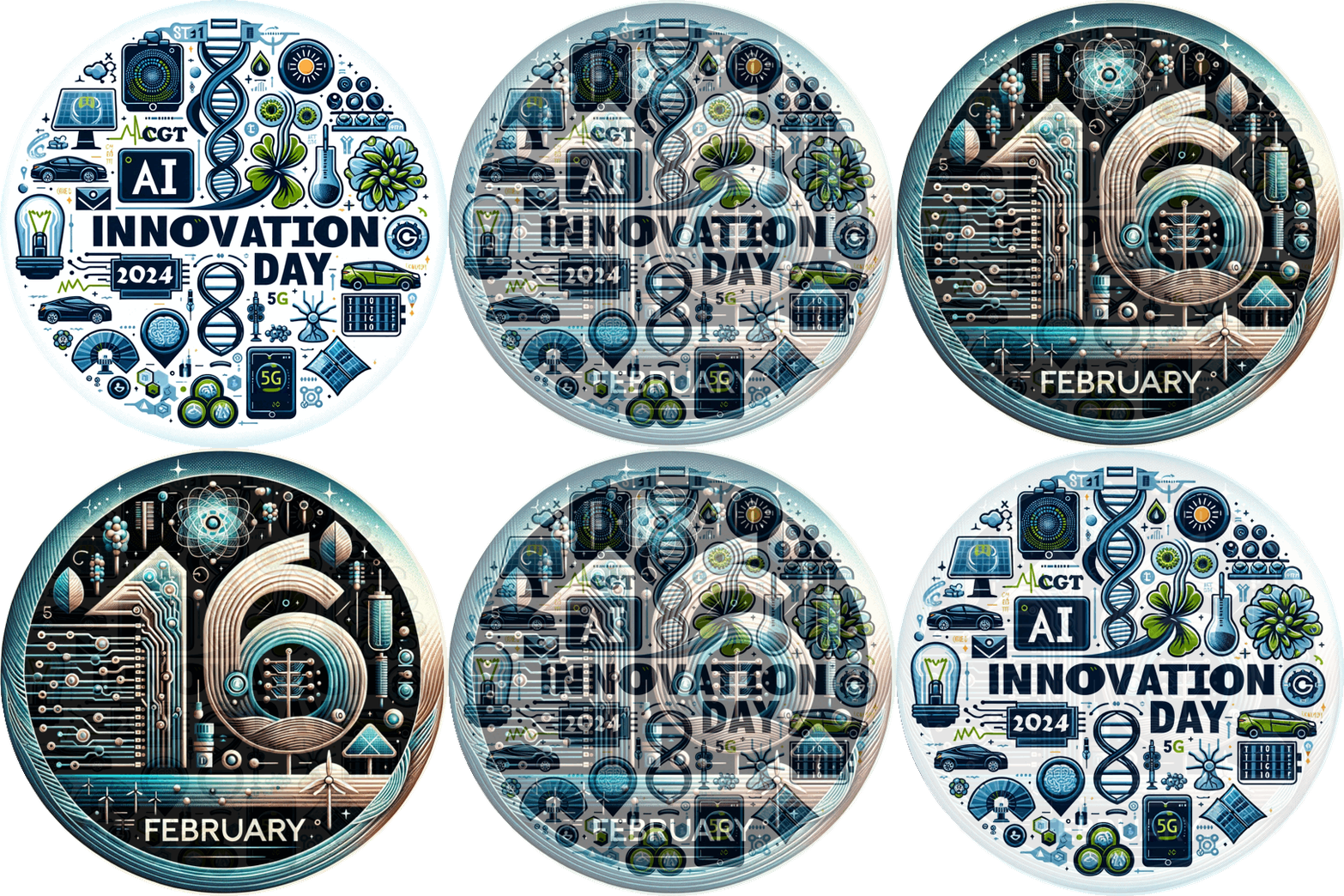
Innovation Day 2024
2024-02-29
Today we celebrate the power of human creativity and ingenuity. At its core, innovation involves implementing something new or improving an existing product or method in a way that adds value or solves problems. It's a driving force behind societal, economic, and technological progress. Examples of the last decade: Artificial Intelligence & Machine Learning: Lately with generative AI, these technologies have revolutionized industries by enabling smart automation, predictive analytics, and personalized user experiences. AI's applications range from healthcare diagnostics to autonomous vehicles, significantly enhancing efficiency and capabilities. Blockchain: Beyond its initial application in cryptocurrencies like Bitcoin, blockchain has introduced a new paradigm for secure, decentralized transactions and data management, impacting sectors such as finance, supply chain logistics, and secure voting systems. CRISPR-Cas9 Gene Editing: It allows for precise editing of DNA, offering potential cures for genetic disorders, advancements in agricultural bioengineering, and treating infectious diseases. Renewable Energy: Innovations in solar and wind energy and improved battery storage have accelerated the transition towards cleaner, sustainable energy sources, mitigating climate change impacts. 5G: Its rollout has marked a significant leap in wireless communication, offering vastly increased speed and connectivity. https://en.wikipedia.org/wiki/Innovation Art&Text 🫶 by ChatGPT.
International Childhood Cancer Day 2024
2024-02-29
International Childhood Cancer Day (ICCD), observed annually on February 15th, is a global campaign to raise awareness and to express support for children and adolescents with cancer, survivors, and their families. There are approximately 400,000 children and adolescents 0-19 years old diagnosed with cancer each year worldwide. Despite advances in treatment, cancer is among their leading causes of death, emphasizing the need for continued research and improved treatments. The most common cancers in children differ significantly from those seen in adults, with leukemia (such as acute lymphoblastic leukemia and acute myeloid leukemia), brain cancers, lymphomas, solid tumors like neuroblastoma (in infants and young children), and Wilms tumor (a kidney cancer) being among the most prevalent. These cancers have varied prognoses and treatment options, which have improved over the years, leading to increased survival rates. However, high-income countries see survival rates of 80% or more, while low- and middle-income countries have survival rates of less than 20%. ICCD serves to raise awareness and promote the need for equitable access to diagnosis, treatment, and care for all children worldwide. It's a call to action to work together to advance research, ensuring that every child has the opportunity to lead a healthy, fulfilling life. https://en.wikipedia.org/wiki/Childhood_cancer https://internationalchildhoodcancerday.org/ Art&Text 🫶 by ChatGPT.
