International Women's Day, March 8, 2024
2024-03-11
International Women's Day (IWD), celebrated on March 8th annually, marks a global observance to honor women's achievements and advocate for gender equality. The day traces its origins to the early 20th century, catalyzed by women's labor movements in North America and Europe. The first National Woman's Day was observed in the US on February 28, 1909, inspired by the Socialist Party of America. In 1910, Clara Zetkin, a German activist, proposed the idea of an international day at the International Socialist Women's Conference, leading to the first IWD in 1911, celebrated in Austria, Denmark, Germany, and Switzerland. A core motive for IWD's inception was advocating for women's suffrage rights. The IWD gained recognition from the United Nations in 1977, which officially invited member states to proclaim March 8 as the UN Day for women's rights and world peace to highlight issues such as gender inequality, violence against women, and the need for gender parity in various sectors. In some countries, IWD is an official holiday, and men honor the women in their lives with flowers and small gifts. While there have been advancements in women's participation in politics and the workforce, significant gaps remain. IWD has mobilized movements, influenced policies, and brought attention to women's rights, showing the power of collective action in driving social change. https://en.wikipedia.org/wiki/International_Women%27s_Day Art&Text🫶ChatGPT.

Berlin Wedding Singers | Berlin Campus Day 24 | Bayer
Welcome to the heart of innovation – the Berlin Campus, a distinguished hub for science, technology, and groundbreaking advancements. Join us on February 27, 2024, starting at 13:00, for an extraordinary event that transcends boundaries and redefines possibilities. You’ve seen and listened to the cheerful Berlin Wedding Singers. Song list - There’s a light - 21 Guns - I’m gonna be - Hey Jude The Berlin Wedding Singers is a choir of Bayer employees, led by Sascha Fagel. You can meet and join them during their weekly rehearsals, every Tuesday 5.30 pm in the Byron Bar in Berlin or just get in touch with sabine.hellmig@bayer.com to learn more about the next set of songs and their upcoming performances. Your presence and active engagement helped us shape the success of this event. Never forget why we are doing what we are doing: together, we redefine the future of science, technology, and innovation. Art by Christopher.blaesing@bayer.com Bayer terms & conditions apply: https://www.bayer.com/en/poap-tc

Together Women Can is extremely happy to share its first "sisterhood story from Kenya" during the Bayer Bayron Bar Valentine's party (Berlin Germany). There will be Love&Science prompt battle pitches generated by AI. TWC presents a wonderful poem about women´s talks and knowledge sharing, all in the frame of health prevention & above all self-love. Come and collect your POAP! Remember that you value, and every one does! #empoweringwomen #ruralkenya #selflove #healthforall #cervicalcancerawereness Web: https://togetherwomencan.co/ LinkedIn: https://www.linkedin.com/company/togetherwomencan/ Email: togetherwomencan.20@gmail.com
The holder of this POAP met Kiliana Suzart-Woischnik at the Bayer Valentine's Day Party 14th of Feruary 2024. This person is probably open minded and highly interested in Innovation, Future of Medicine, Digital Health, and crazy stuff. Kiliana is a Brazilian German Physician, currently working at Bayer Pharmaceuticals in Berlin as Principal Epidemiologist at the Integrated Evidence Generation department. LinkedIn: https://www.linkedin.com/in/kiliana-suzart-woischnik/. Twitter: https://twitter.com/SuzartK.

I met Jesus in February 2024
2024-02-14
Head of Business Disruption, Bayer Pharmaceuticals. I love Stranger Things, MoreScience4Berlin, STEM4Health, Hackathons, Biotech, Digital Health, Startups, Web3, Networking For Health, Science, Technology, Pharma, Medicine, 23andMe, Exobiology, Space, Science Fiction, Germany, Cuba. #OhrSum #Byron #ByronBar #POAP #HackAProcess #ItIsNeverTooLate https://www.linkedin.com/in/yeysus/ https://twitter.com/yeysus yeysus.eth/.tez/.near POAP collections: https://collections.poap.xyz/en-US?creator=0x74839F2fF3bb6F98E5f120329A76A89f52b95DCC Bayer Berlin: https://collections.poap.xyz/bayer-berlin/173 Commemorations: https://collections.poap.xyz/commemorations/1073 The future doesn’t belong to the fainthearted. It belongs to the Brave. - Ronald Reagan's Address to the Nation about the Explosion of the Space Shuttle Challenger, January 28th, 1986. Art Photoshop, PowerPoint, ezgif.com.

Valentine's Day, celebrated on February 14th, is a day dedicated to love and affection. Its origins can be traced to both Christian and Roman traditions. The name "Valentine" likely comes from two Christian martyrs named Valentine who lived in the Roman Empire during the 3rd century. One of the legends surrounding Valentine suggests that he defied Emperor Claudius II's ban on marriages for young men, as Claudius believed that single men made better soldiers. Valentine continued to perform marriages in secret and was eventually arrested and executed on a February 14th. Legend says, he sent a love letter to his jailer's daughter, signing it "From your Valentine," which is a phrase still used today. Valentine's Day gained popularity over the centuries. In the Middle Ages, it became associated with romantic love. In the 19th century, the exchange of love notes and cards became a common practice. Today, Valentine's Day is a global occasion. 200+ million roses are grown, 20+ Billion USD are spent, 190+ million Valentine's Day cards are exchanged in the US alone. Piquant: Among people surveyed, 20% of men purchase gifts for multiple partners, while only 6% of women do the same. Today is perfect for quality time with your partner, or, maybe, embracing the opportunity to finally express affection to your secret love. Be Decent, Virtuous and Brave and —ask them to be your Valentine! More: https://en.wikipedia.org/wiki/Valentine%27s_Day Art by Dall-E, text supported by ChatGPT.

Carnaval de Uruguay 2024
2024-02-14
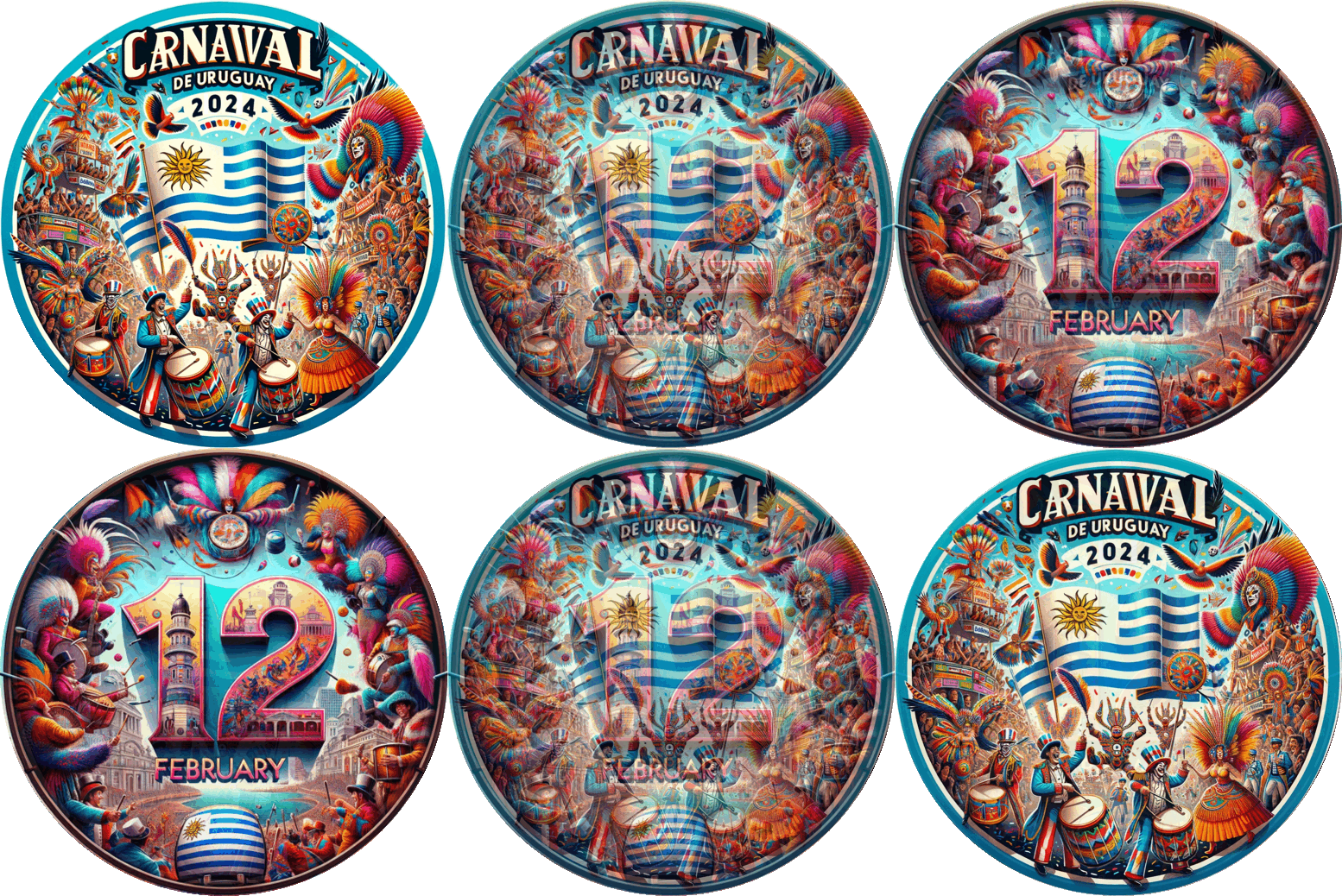
The Carnaval de Uruguay is the longest carnival in the world, extending over 40 days, typically starting in late January and ending in late February or early March. It is rooted in African and European traditions. Central to the carnival are the "Llamadas" parades, which highlight the African heritage through Candombe music and dance, a rhythmic beat played on "tamboriles" (drums). These parades, filled with vibrant costumes and infectious energy, celebrate the country's African roots and community spirit. Another hallmark is the "Murgas," theatrical musical groups that perform satirical and political commentary, reflecting the social and political climate of Uruguay. These performances, characterized by elaborate costumes, makeup, and harmonious singing, are both entertaining and thought-provoking, offering insights into the country's issues and psyche. The carnival also features "Comparsas," which include colorful and dynamic groups of dancers and musicians, parading through the streets, contributing to the festival's lively atmosphere. Additionally, "Humoristas," "Parodistas," and "Revistas" offer comedy, parody, and magazine-style performances, respectively, showcasing the diverse talents of the participants. The Carnaval is a living celebration of Uruguay's identity, unity, and creativity. Salud! More: https://en.wikipedia.org/wiki/Uruguayan_Carnival Art&Text supported by ChatGPT.
Epilepsy Day 2024
2024-02-14
International Epilepsy Day, 2nd Monday of February, raises awareness about epilepsy, a neurological condition affecting people across all ages, ethnicities, and geographical regions. Epilepsy is characterized by recurrent, unprovoked seizures, (Wikipedia) ...abnormal, excessive, and synchronized electrical discharge in (neurons) brain cells... It is one of the world's oldest recognized conditions, with written records dating back to 4000 BC. The term "epilepsy" derives from the Greek word for "attack," reflecting the sudden onset of seizures. The condition's neurological basis was not understood until the 19th century. Globally, epilepsy affects over 50 million people, making it one of the most common neurological diseases. Incidence rates are highest in young children and older adults. Up to 80% of people with epilepsy live in low- and middle-income countries, where access to treatment and care can be significantly limited. The discovery of epilepsy's causes and treatments has evolved over centuries, from ancient misconceptions associating seizures with supernatural phenomena, to the 19th century, when scientists like John Hughlings Jackson began to understand its neurological underpinnings. Today, treatments include medications, surgical interventions, and dietary changes, though approximately 30% of individuals with epilepsy live with treatment-resistant forms of the condition. More: https://en.wikipedia.org/wiki/Epilepsy Art&Text supported by ChatGPT.
